Posted on October 26, 2026
White Light for Bumps in the Night
By: Steve Moses
In my early twenties I had a late-night encounter with a burglar where our initial contact took place in a dark room without the benefit of light from any source. It was not pleasant. Since then as a Texas peace officer I have used a handheld light to clear a burgled apartment, a weapon-mounted light on both handgun and long-gun during dynamic entries, plus participated in multiple force-on-force low-light courses where I used a hand-held flashlight to good effect on other students, as well in which the same was used to good effect on me. A “tactical flashlight” is a far more effective defensive tool than people think when it comes to dealing with suspicious persons whether in parking lots after dark or inside of homes and similar structures.
What is a “tactical flashlight”? One definition might be that it is a small impact and water-resistant illumination tool constructed of aircraft grade aluminum or reinforced polymer that is designed for one-handed operation in stressful situations. The versions that I prefer are ergonomic, feature an easily operated push-button tail cap, and produce intense brightness (250-500+ lumens). One of the best defensive shooting and tactics classes that I have ever attended (so much so that I repeated it two more times) was Armed Movement in Structures taught by Craig Douglas, and it was in this class that I learned how a flashlight that had a strobe function could be used to illuminate a hiding role player in a dark room without giving away my exact location.
What are some of the benefits of using a tactical flashlight for home defense or dealing with an aggressive or suspicious stranger in a parking lot during evening hours?
- It allows us to identify potential threats and threat areas (dark areas in which a threat may be hiding) without pointing the muzzle of our gun at someone or something we are not willing to shoot. Firearms safety rule number two is always in effect regardless of the circumstances. I am hard-pressed to think of a more horrible outcome than when a homeowner mistakes a family member for an intruder and shoots them. A tactical flashlight can quickly tell us whether the person we are illuminating is a family member or a stranger.
- A blast of sufficiently bright light in the face of either a home intruder or aggressive stranger exhibiting pre-assault tells in a parking lot will cause abrupt contraction of the pupils and temporarily “short-circuit” their low-light vision. This gives the defender an opening to break contact or use greater force if necessary to avoid being assaulted, sexually assaulted, kidnapped, injured, or killed.
- A skilled defender can use a tactical light with a strobe function to make it difficult for an armed intruder to ascertain with any accuracy their location.
- If an armed defender is forced to move quickly into a structure from the outside or through an interior doorway, proper use of the flashlight can prevent them from being backlit (silhouetted against a bright background).
- If a lethal force response is required in order to stop a deadly threat, the armed defender should be able to better see the sights on a handgun equipped with iron sights or a dot on a handgun with pistol-mounted optic.
- I think it is a bad idea to go hunting for intruders unless it is absolutely necessary to leave wherever I am in the residence and protect someone else that lives or is staying there. If I station myself in a “hard corner” (this is a corner that is on the same wall as the door) then the intruder must insert enough of his or her head in the room to see me. A sudden blast of blinding light right in the face could allow me to see whether he or she is a dangerous threat or not.
The negatives of using a hand-held tactical light are few, but they do exist. In the words of firearms and tactics trainer Craig Douglas, they can be a “bullet magnet” for their tendency to give away the location of the defender. There are techniques that can go a long way towards masking the defender’s location while still effectively illuminating a suspicious person and clearing threat areas that might be occupied by an intruder. Armed defenders should keep in mind that many “suspicious persons” turn out to be family members or even uninvited individuals who do not pose an immediate deadly threat. Another negative is that the user is usually unable to grip the handgun with both hands which can affect accuracy. I am unable to emphasize the importance of technique when it comes to using flashlights in conjunction with firearms. Almost everything seen on television and in the movies involving room clearing with flashlights is wrong.
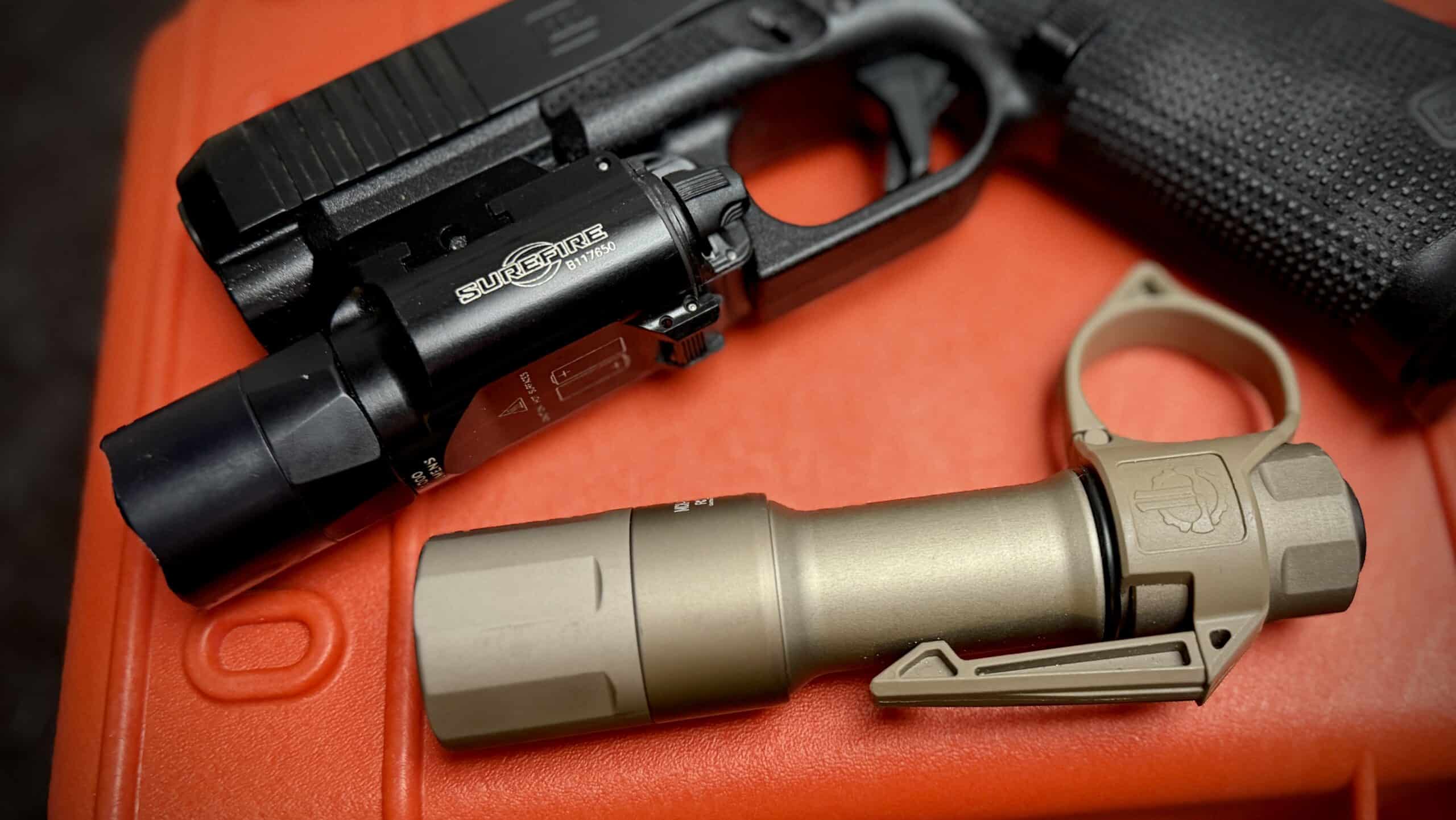
What about weapon-mounted lights? I ran a Surefire weapon-mounted light on a Glock 17 when I was a member of a multi-precinct Special Response Team. Surefire flashlights have a well-deserved reputation for durability and reliability, and there was always a chance that our gear would take a beating during training exercises and execution of high-risk writs. I am no longer a law enforcement officer, but I still keep a weapon-mounted light on my dedicated home defense pistol. I would not use it to clear my house or leave my bedroom unless I needed to. I don’t want to be forced to point my muzzle at anyone or anything that I am not willing to shoot in order to illuminate a suspicious person or threat area. The beauty of the weapon-mounted light for me is the ability to free up a hand to dial 911, grab a child, open a door, or anything that requires a free hand.
Armed defenders should have flashlights in their home, their vehicle, and on their person while out in public. The tiny rechargeable Streamlight Microstream LED flashlight sells for about $40 and has a maximum output of 250 lumens. For those of us that would rather go big than go home, the lightweight Surefire Stiletto and Stiletto Pro are what I think are the gold standards. My response to those who say flashlights are not necessary for daylight hours is that it is possible to find ourselves in an interior room that has no outside windows when the electricity goes off. I think about this every time that I go to a movie theatre. This is also true for businesses and Houses of Worship that have interior sanctuaries surrounded by hallways.
If I leave enough lights on in my house at night outside of the bedrooms then I may not have to rely on a hand-held flashlight to see an intruder. I am still going to take one with me for no other reason than a blast of white light into another person’s face gives me both a decided advantage and may keep me from shooting someone that I do not want to shoot.
About Steven Moses
Steve Moses is a martial arts, firearms, and defensive weapons instructor based in Texas. He has decades of experience training civilians and law enforcement officers in multiple states. He has served as a reserve deputy and Special Response Team member, and he is a competitive shooter. He also has extensive experience in church security and executive protection. He is currently the Director of Training at Palisade Training Group.