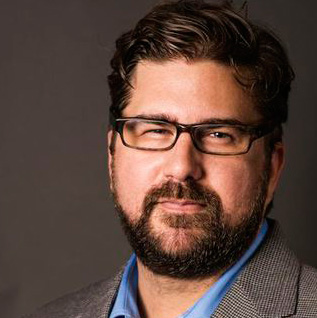
David Crofut rear-ended Gerald Strebendt on a dark stretch of the Bob Straub Parkway near Springfield, Oregon. You may remember from Lesson 3 that, when Strebendt got out of his truck, Crofut began “yelling and making threats” as he exited his own vehicle and approached. Crofut didn’t know the man he confronted once served as a Marine sniper and fought professionally as a mixed martial artist nicknamed “The Finishing Machine.” Strebendt grabbed a rifle he had in his truck, called 9-1-1, and backed away.
The 9-1-1 recording captures Strebendt shouting: “Stay back!” Moments later, he says, “I’m backing away from him. Back away! Yes, he’s coming at me.” He tells the operator: “I’ve got a loaded weapon and he’s coming towards me.” After a short exchange, Strebendt continues: “He’s … get back from me, sir. Get back from me. Ma’am,” he says, talking to the operator, “I can’t see his hands. It’s dark. I can’t see him.” Five seconds later, a shot rings out. Strebendt shot Crofut—a single fatal round to the head.
In the moments following the crash, Strebendt did many things right. He called 9-1-1. He backed away from the aggressor. He tried to de-escalate with verbal cues. Touch DNA evidence reinforced Strebendt’s claim that he didn’t fire the fatal shot until after Crofut had touched the rifle, ”clasped the barrel,” as his attorney Mike Arnold put it. It wasn’t Strebendt’s actions during the confrontation that damaged his self-defense claim; it was his actions in the moments, days, and weeks before that fatal encounter that crippled his legal defense.
According to reporting from KMTR, “Strebent’s ex-wife told police her ex-husband was involved in road rage incidents ‘all the time.’ She estimated that 3 to 5 times a week, Strebendt would ‘brake check’ and cut off other drivers.” After the shooting, Crofut’s wife told police that Strebendt had cut them off from the right-hand lane, and investigators concluded that Strebendt had stopped his GMC pickup truck in the road at an angle, blocking traffic. Strebendt didn’t know the driver he brake-checked had a blood alcohol concentration nearly twice the legal limit to drive. Strebendt clearly didn’t expect Crofut to strike his vehicle, but he must have anticipated—even hoped for—some kind of confrontation.
Six days before the shooting, Strebendt posted this message on Facebook: “If you like to drive slow guess what? You should be in the slow lane. If you want to drive greater than the speed limit guess what? You should be in my lane. If you get this confused somehow guess what? I will strike hard and fast like a cobra should the opportunity present itself.” Strebendt lived out that Facebook post, prosecutors would argue, on the night of January 29, 2014. As evidence of his prior bad acts and the history of aggressive behavior mounted, Strebendt, facing the threat of a 25-year-mandatory minimum sentence, accepted a plea deal that resulted in 58 months in prison.
Gerald Strebendt had a history of provoking confrontations, confident that his Marine Corps training and his mixed martial arts resume virtually guaranteed he’d win any physical fight that resulted. However, his training had not prepared him for the legal fight that would follow a deadly confrontation, and he almost certainly didn’t understand that provoking a fight could completely undermine a self-defense claim.
Criminal defense attorney Don West explains, “Classic provocation is setting a trap—enticing, baiting, or encouraging someone to do something with the idea that you’ll be the justified one when or if something happens.” In some cases, provocation involves literally setting a trap and creating the circumstances to attempt to justify a homicide, but that’s relatively rare. More commonly, as in the Strebendt case, the provocateur merely wants to force a verbal confrontation. “They subtly want something to happen so they can win the argument,” Don says, “or teach the lesson, or have the excuse to put that person in their place—and no one expects it to result in gunfire and death.”
For Lesson 11, we’ll explore three cases that began with a blatant provocation and ended in gunfire and death. We’ll begin in the outskirts of New Orleans, where prosecutors accused Ronald Gasser of setting a trap to kill another motorist after a long road rage incident. Then we’ll travel to Missoula, Montana, to re-examine the Markus Kaarma case, where the shooter literally set a trap for a would-be burglar. We’ll end in Austin, Texas, with the now-familiar case of Daniel Perry, where a confluence of provocations led to a controversial use of deadly force.
***
Ronald Gasser became emotionally hijacked, as you may remember from Lesson 8, when another motorist, Joe McKnight, driving an Audi SUV, cut off Gasser’s blue Infiniti in traffic. Gasser retaliated in kind, sparking what investigators described as a “tit-for-tat” incident— mutual road rage during which Gasser and McKnight gave each other the finger and yelled vulgar names at one another while driving erratically for about five miles. Witness Jerrod Jones said, “I saw them weaving in and out of traffic … side by side jockeying for position down General DeGaulle Avenue.” The confrontation ended with Gasser fatally shooting McKnight.
According to local reporting, in the aftermath of the shooting, “a visibly nervous and animated Gasser told Detective Brad Roniger that, after McKnight cut him off, the two were yelling at each other as they drove across the bridge to the West Bank.” Gasser claimed that McKnight “kept begging for me to stop,” but he refused. When the two turned off onto General De Gaulle Drive, Gasser admitted that he reached into his gym bag and took out his gun. The conflict came to a head when the motorists stopped at a red light at the corner of Behrman Highway and Holmes Boulevard.
At the intersection, McKnight got out of his car, walked to the passenger window of Gasser’s blue Infiniti, and leaned in, resting his arms on the frame of the lowered window. Gasser claimed that McKnight “lunged” toward him, and he shot the attacker, striking him three times, including one fatal shot to the chest. In Louisiana, when an intruder crosses the threshold of your vehicle, it triggers legal protections for the defender, similar to the Castle Doctrine. If the defender is lawfully in his vehicle when the conflict began, and the other person is attempting to “make an unlawful entry,” then Louisiana law, at the time of this writing, states that deadly force could be justified.
A critical question at trial, however, was whether or not Gasser invited the confrontation at his passenger window. A witness to the shooting, Veronica Hoye, testified that she heard McKnight yell, “No, you get out of your car!” It suggested that Gasser had essentially invited McKnight to exit his vehicle, and despite McKnight’s initial objections, he ultimately accepted the invitation by walking over and leaning into Gasser’s car. During closing arguments at Gasser’s murder trial, Assistant District Attorney Seth Shute told jurors, “The trap is sprung. When Mr. McKnight accepted his invitation to get out, he shot him.” That’s Don West’s definition of “classic provocation.”
Jurors seemed to agree that Gasser provoked the confrontation at his passenger window. Still, they also had to decide whether Gasser provoked McKnight with a “specific intent to kill or to inflict great bodily harm,” which would be second-degree murder—and also whether “the offense [was] committed in sudden passion or heat of blood immediately caused by provocation sufficient to deprive an average person of his self-control and cool reflection”; manslaughter under Louisiana law. The jury’s manslaughter verdict suggests they felt that, although Gasser’s use of deadly force was not justified, Joe McKnight was also complicit in provoking the deadly confrontation.
Firearms instructor Steve Moses notes that both men missed opportunities to disengage or de-escalate during the five-mile road rage encounter. Steve says, “I see this as an unfortunate scenario where two jerks ran into each other with no give on either side, and it’s not surprising to me that this was the outcome.” It’s worth noting that, had the tables been turned—if Gasser had accepted McKnight’s invitation to come to his vehicle and the encounter spiraled out of control—it might have been Gasser lying dead on the ground and McKnight sitting before a jury.
For an armed defender, any angry confrontation has the potential to escalate to violence and result in the use of deadly force. If you’re the one who provoked the confrontation—even if you didn’t throw the first punch—it could severely complicate your self-defense claim. Don West says, “Another way to look at provocation might be as an invitation to mutual combat. You can’t very well challenge somebody to a fight, let them know you’re more than willing to mix it up, and then complain if you get a bloody nose.”
***
While there is reasonable doubt regarding whether Gasser intended to commit murder when he invited McKnight to his open car window, there is less confusion about Markus Kaarma’s intentions when he blasted four shotgun shells into his darkened garage. By his own words, he intended to kill whoever was inside.
Ten days before the shooting, a burglar snuck into Kaarma’s garage at night. Kaarma and his partner, Janelle Pflager, often kept their garage door slightly open for ventilation when they smoked in the garage—so the intruder didn’t have to break in when they absconded with a credit card and an iPhone on April 17, 2014. Pflager, unsatisfied with the law enforcement response to the burglary, called the stolen iPhone and, remarkably, the perpetrator answered. Next-door neighbor Terry Klise testified at trial that Pflager yelled over the phone, “If you come back into our garage, you will be killed.”
Markus Kaarma also telegraphed his murderous rage. Six days after the burglary, four days before the shooting, Kaarma told his hairdresser at Great Clips that he was tired because he had been up the last three nights “waiting with his shotgun for some kids to come back into his garage again.” Before leaving his appointment, Kaarma added, “And I’m not (expletive) kidding, you’ll see this on the (expletive) news. I’m going to (expletive) kill ’em.”
In a Supreme Court ruling related to the case, justices wrote, “Witnesses testified that Pflager knew the burglars would come back because ‘we are going to bait them,’ and that their guns were loaded.” As reported in the MIssoulian newspaper, “Pflager told police that she intentionally placed a purse in the garage ‘so they would take it,’ and left the door open 5 ½ feet. Then she placed a baby monitor in the garage and installed motion sensors outside.” At trial, Pflager hedged on using the purse as bait, but she made a revealing admission: “Of course, I would have this whole fantasy that I was going to get someone.” In an interview with police, Kaarma allegedly said Pflager left the garage door partially open to “entice the suspects.” He said the trap was her idea.
If Pflager set the trap, Kaarma activated it. According to the Supreme Court opinion, “In the early morning hours of April 27, 2014 … Kaarma and Pflager saw on the security camera an intruder enter their attached garage.” The opinion continues, “Kaarma took his shotgun, walked out the front door of the home, turned and stood in front of the partially open garage door.” Kaarma “fumbled with the shotgun, and discharged four shots into his garage in a sweeping motion from right to left.” He struck the intruder twice—once in the arm and once, fatally, in the head.
The intruder was a 17-year-old German foreign exchange student named Diren Dede. Testimony suggested Dede had learned about garage hopping from his American friends–the art of sneaking into neighbors’ garages to pilfer beers. Regardless of Dede’s intentions, Don West says Dede committed a crime by entering the garage, a potential burglary. “Burglary,” Don explains, “basically means trespassing in someone’s home with the intent to commit another crime. It’s usually theft, and a garage would count. This would have been burglary had the kid been caught stealing and then prosecuted. It’s a serious crime.” But did the crime justify the deadly force response?
The Castle Doctrine allows someone in their home to presume an intruder means to inflict harm—especially if they enter the home forcibly. The problem for Kaarma is that Dede entered through an open garage door, with no force required. Moreover, evidence shows Kaarma, Pflager, and their young child were safely behind locked doors when they detected the intruder. Kaarma intentionally left a place of safety and went outside his home to meet the threat. Don West says, “Kaarma did everything he could to ultimately undermine any possible defense he had by the way he was remorseless and the way he was broadcasting his intent. If you do or say anything that makes it appear as if you’re looking for trouble, people may hold you accountable for it.” After hearing the gunshots, neighbor Jessica Bracey, who had heard her neighbors’ rants, mentioned to her husband: “They baited them in there.”
Diren Dede, by the way, had never been in Kaarma’s garage before. Tristan Staber and Mykel Martin were charged in the April 17 burglary and admitted their roles at trial. After eight hours of deliberation, the jury convicted Kaarma of deliberate homicide, and Judge Ed McLean sentenced him to 70 years in prison. Pflager never faced criminal charges, though the Dede family’s civil suit named her alongside Kaarma before it ended in an undisclosed settlement.
***
Janelle Pflager set a trap, and Markus Kaarma sprung it—but provocation is not always quite so cut-and-dried. Sometimes, instead of setting a baited trap, an armed defender may seek a circumstance where they feel they’d be justified in using deadly force. That might be what happened in the Daniel Perry case. You may recall from previous lessons that Daniel Perry found his Hyundai sedan swarmed with protesters when he turned into a column of marchers crossing Congress Avenue in downtown Austin, Texas, on the evening of July 25, 2020. The chaotic encounter ended with Perry firing five rounds, killing an armed protester named Garrett Foster,
In the weeks and months following the police killing of George Floyd, Perry expressed his frustration at the protests that flared up across the country, including in Texas cities. “It’s official,” Perry wrote on Facebook, “I am a racist because I do not agree with people acting like animals at the zoo.” Investigators found a text message Perry sent on May 29, 2020, which read: “I might go to Dallas to shoot looters.” The text was almost certainly bluster, but it revealed a troubling mindset that Perry had been developing.
Just as Pflager admitted that she had “a whole fantasy that [she] was going to get someone,” Perry had envisioned a circumstance where he might be justified in shooting a rioter. In a Facebook Messenger exchange with his friend Justin Smith, Perry wrote: “I might have to kill a few people on my way to work they are rioting outside my apartment complex.” Smith responded, “Can you legally do so?” Perry replied, “If they attack me or try to pull me out my car then yes. If I just do it because I am driving by then no.” Weeks before the shooting, Perry’s visualized a circumstance very similar to what he encountered on July 25th.
Two weeks after his exchange with Smith, Perry traded messages with Michael Holcomb, discussing a video of a driver who shot a man reaching into his car during the Seattle Capitol Hill protests. Perry argues, “The video clearly shows the protestor punching the guy in the head while trying to pull him out of the car by his neck.” Holcomb responds: “What was the guy doing before that though? If he was driving into protestors or threatening them with his gun (some people have been recorded doing this) then he may have incited violence. Even in Texas, if you incite the incident [and] inflame the situation then it will not be a good shoot.”
Four days later, Perry exchanged messages with Holcomb about the case of Steven Ray Baca in New Mexico. Baca went to a protest carrying a .40-caliber pistol. He physically assaulted two female protesters and ran when the crowd chased him. Perry describes the video to Holcomb: “[A] guy is being chased by protestors one of them knocks him down and yells ‘I am going to kill you’ while swinging a skateboard at they guys head and then he shoots the protestor multiple times.” Holcomb responds that “the guy with the gun is the one that incited violence. He was pulling people over and on the video he pulls and shoves a woman to the ground for seemingly no reason before the protesters turned on him.” Holcomb later writes: “Ending up in a bad situation and looking for one are not the same thing.”
When Daniel Perry ultimately drove his car into a column of demonstrators, as protesters swarmed around his car, kicking it and pounding it, Perry noticed an intimidating figure approach his driver’s-side window. Garrett Foster, a 28-year-old Air Force veteran, carried an AK-47-style and was dressed in tactical gear. Perry grabbed his .357, rolled down the window, and fired five rounds, including a fatal shot to the chest. Perry sped away and called 9-1-1. Claiming self-defense, Perry wasn’t arrested for a year, but he ultimately faced a murder charge.
During opening statements at Perry’s trial, prosecutor Guillermo Gonzalez told jurors, “Evidence will show that Perry instigated events that night, and it was Perry who engaged in unlawful use of force by driving his car into the crowd.” Jurors would ultimately have to decide whether Perry simply ended up in a bad situation or whether he was looking for one. Don West said, “I think he really stacked the deck against himself. We don’t know if any of this was a self-fulfilling prophecy, but it sure sounds like it was—that he intentionally inserted himself in one of those fantasy scenarios that he was talking about online.”
Steve Moses reminds us that, tactically, appearances can mean more than intent. “In terms of being provocative, that may have been unintentional on Perry’s part, but it really doesn’t matter because his actions were provocative.” The guilty verdict suggests the jury believed Perry provoked the resulting violence. Governor Greg Abbott’s pardon just over a year later demonstrates how controversial the case was; Garrett Foster, after all, by openly carrying a rifle at a protest, was being provocative, too. Perry’s twisting legal drama illustrates the complicated ambiguities associated with provocation in self-defense cases.
***
Responsible gun owners would never dream of staging a trap as Markus Kaarma and Jeanelle Pflager did. Most of us, however, if we’re honest, are susceptible to triggers that could lead to road rage. And some of us may have even envisioned a scenario where we might be considered legally justified in using deadly force against some bad guy who had it coming. The trouble comes when those visions become vigilante fantasies.
Steve Moses believes Daniel Perry “allowed his preparations to establish his mindset.” Steve says, “I think he decided, if “A” happens, I’m going to respond with “B,” and he ended up putting himself in a position where he felt that “B” was the only response that he had.”
“In many instances,” Steve says, “ people see what they think they’re going to see. If I expect to find myself someday in a situation where I need to use my gun, and then I find myself in a similar situation—but maybe not exactly the same—I may very well think that I’m in imminent danger, even if I’m not.”
Mike Arnold, the criminal defense attorney who represented Gerald Strebendt, wrote that Gerald’s legal ordeal made him think about his own behavior. A scrappy former rugby player, Mike wasn’t one to shy away from a physical confrontation. “I never threw the first punch,” Mike writes, “but I often started the fight by asking for it with my mouth.” He adds, “I’ve never gone looking for trouble, but I’ve always been ready for it. And maybe that readiness has helped me find it.”
Mike’s not suggesting armed defenders shouldn’t be ready to face a physical fight. But an armed defender who often thinks about when they might justifiably use their weapon could be building a mindset that unconsciously fosters those circumstances. Conversely, an armed defender who imagines how they might escape a confrontation without using their gun can build a mindset where they avoid most potential self-defense encounters before they ever turn violent.